News
Coin Collecting for Beginners: A Practical Guide to Building Your Collection
Coin collecting is often called the king of hobbies, and it can be as fascinating as it is rewarding. You are not just buying a small item, you are holding a piece of history that has passed through real hands and real moments in time. It is that feeling that first drew me to coins too. I’ll show you practical ways to start collecting by time period, monarch, denomination, or rarity, and how to buy with confidence by understanding condition, storage, and the basics of safe online buying.
- What is coin collecting?
- How to start coin collecting
- Common coin types you’ll see (and what they mean)
- What to look for on a coin (the quick basics)
- Grade (condition): why it matters so much
- Cleaned coins: what it means (and how to handle it)
- How to read coin photos (so you can buy with confidence online)
- Rarity and scarcity: what makes a coin harder to find
- Where to buy coins (online and in person)
- A simple quick-start checklist (so you can begin this week)
If you are new to collecting, it is normal to feel a bit overwhelmed by terms like uncirculated, graded, or mint mark, and by the huge range of prices you will see online. Th good news is you do not need to be an expert to begin. With a simple plan and a few basic checks, you can buy confidently, avoid common mistakes, and enjoy the history behind each coin.
In this guide, we’ll cover practical steps: how to choose a collecting theme, what condition really means, how to store coins safely, and where to buy. As a coin dealer based in Scotland, our guide is written with UK buyers in mind, but the advice works worldwide.
What is coin collecting?
Coin collecting is the hobby of building a collection of coins you find interesting, meaningful, or enjoyable to own. Some people start with modern UK coins from their change, then branch out into older British coins, world coins, or a particular era such as Roman coins or Victorian coins. Others focus on a specific monarch, denomination, or metal. There really is no right or wrong way to start. A good place to begin is with whatever you’re naturally drawn to, then refine your focus as you learn what you enjoy owning.
You’ll also see the word numismatics. Numismatics is the study and collection of currency, including coins, banknotes, tokens, medals and more. People use “numismatics” and “coin collecting” in similar ways, but numismatics can also include the history behind the objects, how they were made, and why they were used.
The history of coin collecting
Coin collecting is not a new hobby, it has been around for centuries. Even in the ancient world, the Roman Emperor Augustus is said to have enjoyed coins and to have gifted interesting pieces to others. For a long time, serious collecting was mostly for the wealthy, but today it’s far more accessible. You can start with one coin you like and build a collection at your own pace.
Why do people collect coins?
People collect coins for all sorts of reasons. For some, it’s about history you can hold, or the satisfaction of building a set over time. For others, it’s the design and craftsmanship, the thrill of finding a scarcer issue or key date, or tracking down an example in better condition (higher grade). Some people are also drawn to the investment side of the hobby.
At JWB Coins & Collectables, we’re here to help you build confidence as you go. Ready to start your collection journey? Read on and we’ll discuss how to start collecting coins, including a few different collecting paths you can choose from.
How to start coin collecting
If you’re not sure where to begin, the simplest approach is to pick one area that genuinely interests you and start there. It keeps the hobby enjoyable, and it gives you an easy way to decide what to buy next.
From there, choose one clear collecting path. There’s no perfect choice, just a focus that makes it easier to decide what to keep, what to pass on, and what to look for next. It also helps you learn faster, because you start noticing patterns in dates, designs, metals, and condition. Here are a few common collecting paths, with examples to help you choose a starting point.
Collecting by era or period
If you’re drawn to a particular time in history, collecting by era is a satisfying way to start, and it gives your collection a clear direction. It’s genuinely fascinating to hold something that may have been carried, spent, and saved by generations of people, long before it ended up in your collection. You might focus on Roman coins, medieval and hammered coins, Victorian issues, pre-decimal Britain, or modern decimal coinage to name a few. This path makes it easier to learn, because you start recognising the same portraits, inscriptions, and styles as you go.

Collecting by denomination or coin type
Some collectors choose one denomination and try to build a neat, consistent set. Classic British examples include pennies and halfpennies, threepence, sixpence, shillings, florins and halfcrowns, as well as modern 50p and £2 coins. This approach is great for beginners because you’re comparing like-for-like, so differences in date, condition (grade), and design stand out more clearly.
Collecting by monarch or ruler
A simple focus is to collect coins from one monarch, or build a “monarch run” over time. In the UK that might mean starting with Victoria, Edward VII, George V, George VI and Elizabeth II, then expanding as your budget and interest grows. It’s a natural way to organise a collection, and it helps you spot design changes and key dates within a reign.

Collecting by metal
Collecting by metal is popular, especially if you’re drawn to silver or gold. You can keep it simple by choosing one metal (for example, silver pre-decimal) or by deciding you only want precious metal coins, whether they’re older circulating pieces or modern bullion issues. Some people also like this route because it can overlap with an investment-style collection, without taking away the enjoyment of collecting. Budgets can vary massively here, and prices can move up and down with metal values, so it’s worth deciding early whether you’re collecting mainly for the history and designs, the metal content, or a mix of both. It’s a clear filter when you’re browsing, and it can help you keep a consistent focus if that’s what you want.
Collecting by country or region
Collecting by country or region works brilliantly if you want your collection to tell a wider story than one place. You can keep it simple with a “round the world” set, or focus on one country and learn its designs, rulers, and currency changes over time. Some collectors also build collections around big chapters of world history, like coins from an empire, a trade period, or wartime issues, because the coins reflect real changes in power, borders, and everyday life. It’s a satisfying route if you enjoy learning as much as buying.
Collecting by currency
Collecting by currency is a simple way to give your collection structure. You might focus on British coins, then choose a clear sub-focus like pre-decimal Britain or modern decimal coinage. You can also take this approach with a specific area you enjoy, such as Scottish issues or English hammered coins, depending on what you’re most drawn to. This route makes it easy to see change over time, because currency shifts tend to sit alongside changes in monarchs, designs, metals, and the wider story of the period.
Collecting by theme or historical event
If you like the idea of collecting coins with a clear bit of history behind them, you can focus on a theme, event, or purpose. That might include commemoratives, military-related pieces, or coins tied to a particular period in British history. This route keeps the hobby fun and personal, and it gives you an easy way to explain your collection to other people without needing specialist terminology.

Common coin types you’ll see (and what they mean)
Circulation coins
These are everyday coins made to be spent. In other words, they’re coins that were issued for normal use in shops and day-to-day life, so many examples show some wear from being handled and carried. Many collections start here, and older circulation coins are often a great way to learn without spending a lot.
Uncirculated coins
Uncirculated means a coin has not been used in day-to-day spending, so it has no wear from circulation and keeps more of its original finish. You may also see the term Brilliant Uncirculated (BU), especially on modern coins. BU is commonly used for uncirculated coins that look particularly fresh, with sharper detail and brighter surfaces than a typical circulated example, but it is not the same as proof.
Proof coins
Proof coins are made with collectors in mind, using specially prepared dies and extra care in striking. They typically have sharper detail and a distinctive finish compared with circulation coins. Condition matters a lot with proofs, so it’s worth learning what to look for before paying a premium. The finish varies by issue, but proofs are made to a higher presentation standard than coins struck for everyday spending.
Commemorative coins
These are issued to mark an event, anniversary, or person. Some are made for circulation, and others are collector issues, sometimes sold in presentation packs or sets. They’re a fun area to collect because there’s so much variety in designs and themes.
Bullion coins
Bullion coins are valued mainly for their precious metal content (usually gold or silver). Prices move with the metal market, and condition tends to matter less than weight and purity, unless you’re buying a scarcer date or a coin that also has collector demand.
Ancient and hammered coins
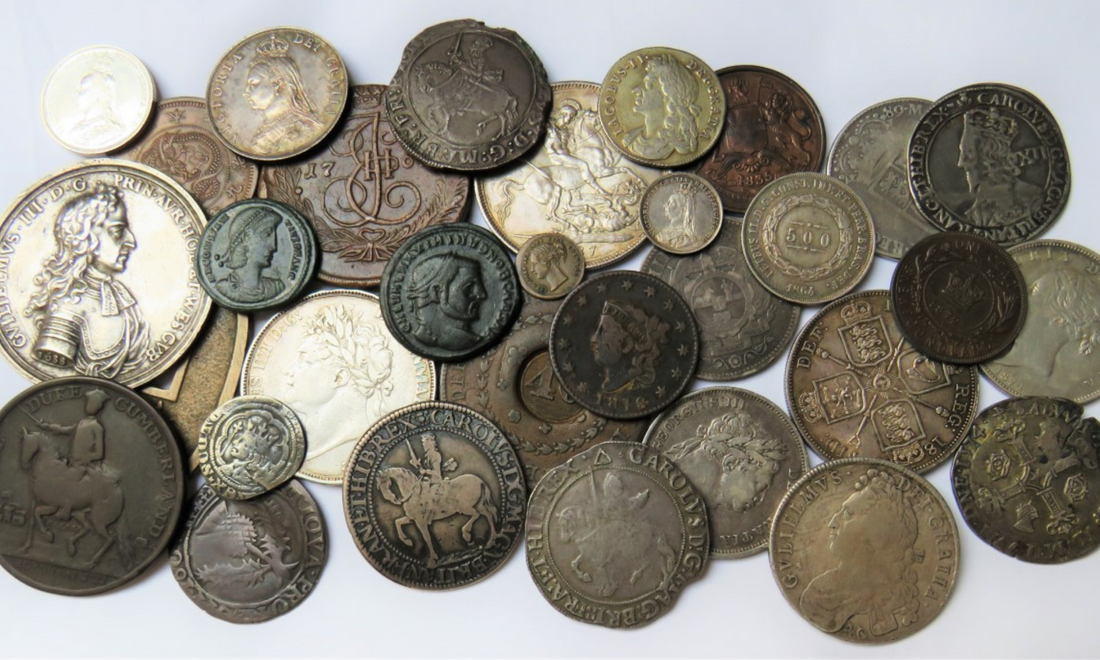
Most modern coins are machine-made, which gives them a regular, uniform look. Ancient coins and hammered coins were made differently, so you’ll see more natural variation from coin to coin. Many were struck by hand, using a hammer to impress the design onto a blank piece of metal, which is why details and shape can vary even within the same type.
Errors and varieties
An error is a genuine mistake made during the minting process. For example, a coin might be struck off-centre, or show a doubled design where parts of the lettering or portrait look repeated.
A variety is a recognised difference within the same coin type, usually caused by a different die or a design change. Some varieties are obvious, and some are subtle. For example, you might see differences in the size or style of lettering, a small change in a portrait, or a slightly different design detail on the reverse.
Some varieties happen because the design was updated on purpose, and others are simply differences that occurred during production and became a known “type” collectors look for.
What to look for on a coin (the quick basics)
Before you buy a coin, it helps to know what you’re actually looking at. In this section we’ll walk through the basic coin anatomy you’ll see on most coins, like the obverse and reverse, the date, the rim and edge, and where a mint mark may appear. Once you know these, it becomes much easier to read listings and compare coins with confidence.

Obverse and reverse (front and back)
Most people think of the obverse as the front and the reverse as the back. On many coins, the obverse is the side with the main portrait or national emblem, and the reverse is the side with the value and a different design. You’ll often see listings describe a coin as “obverse” and “reverse” rather than “heads” and “tails”.
Date
The date tells you when the coin was made, but it can also hint at rarity. Some dates are much harder to find than others because fewer coins were minted that year, or because fewer survived in good condition. That’s one reason two coins that look similar at first glance can be priced very differently.
Mint mark (if present)
A mint mark is a small letter or symbol that shows where a coin was made, or sometimes which mint produced it. Not every coin has one, and where it appears depends on the country and time period. When it does appear, it can matter because the same design and date can exist with different mint marks, and one version may be scarcer.
On some British coins, you may see a small letter or mint signature that points to where it was struck, but it isn’t something you’ll find on every issue. If you’re unsure, it’s fine to treat mint marks as an “extra detail” to learn once you’re comfortable identifying the coin itself.
Rim and edge
The rim is the raised border around the coin. The edge is the “third side” of the coin, which might be plain, reeded (grooved), or lettered. Damage here is common because coins get knocked, dropped, and clink against other coins in circulation. Look out for dents, nicks, flattening, or signs a coin has been mounted in jewellery. Rim and edge damage can affect value, and it can also be a clue that a coin has seen heavy use.
Condition (circulated vs uncirculated)
Condition is one of the biggest drivers of value. A circulated coin has been used in everyday spending, so it will likely show some wear. An uncirculated coin has not been used in circulation, so it keeps more detail and original finish. Two coins of the same type and date can be worlds apart in price purely because of condition.
Grade (condition): why it matters so much
The condition of a coin, more commonly referred to in numismatics as its grade, is one of the main reasons two of the same coin can be priced very differently. Grade is a way of describing a coin’s condition, mainly by looking at how much wear it has from use and handling.
It’s also important to keep expectations realistic for the kind of coin you’re collecting. A modern coin can survive in high grades because it’s newer and mass-produced, while an older coin, or a coin that circulated heavily, may be genuinely hard to find in sharp condition. With ancient, medieval, and hammered coins, you’ll also see more variation because of how they were made and how long they’ve been around. In other words, what counts as a high grade depends on the coin.
When you’re comparing coins, try to separate two questions. First: what is it? (type, date, denomination, ruler or design). Second: what condition is it in? (the grade). Two coins can be the same type and date, but look and price very differently because one has more wear, marks, or surface issues than the other.
Where to look for wear (a simple tip that helps a lot)
Wear typically shows first on the highest points of the design. On portrait coins, that might be the hair, cheek, jawline, or crown details. On the reverse, it might be the centre of a shield, the tops of lettering, or the highest parts of an animal or emblem.
You’ll also see marks and scuffs in the flatter background areas (called the fields). These are not always “wear” in the same way, but they still affect how a coin looks and how desirable it is.
Grading is not an exact science
Grading is a real skill, but it involves judgement, especially when a coin sits between two grades. That’s normal in the hobby. The best approach is to use the grade as a helpful guide, then rely on clear photos and a detailed description to decide if a coin is right for you.
Coin grading terms (UK)
In the UK, coins are commonly described using a grading scale that runs from Poor (a coin with very heavy wear and minimal detail left) up to Extremely Fine (a coin with only light wear, mainly on the most raised parts of the design).
The grades you’ll see in between are:
Poor (P), Fair (FR), Good (G), Very Good (VG), Fine (F), Very Fine (VF), Extremely Fine (EF).
You’ll also see some other terms used alongside the traditional scale:
Proof - specially made collector coin, struck to a higher standard with sharper detail and a distinctive finish. Proof coins are not made for circulation, and they’re often sold in presentation packaging.

High grade - Sometimes we’ll describe a coin as high grade when it’s a particularly strong example for its type, with better detail, fewer marks, or a more attractive overall appearance than you’d normally expect.

Next, it’s worth covering one of the biggest beginner pitfalls: cleaned coins. Cleaning can make a coin look brighter in photos, but it can also damage the surface and reduce its desirability to collectors. Knowing what to look for will help you buy with more confidence, especially online.
Cleaned coins: what it means (and how to handle it)
When collectors say a coin is cleaned, they usually mean the surface has been altered in a way that leaves visible signs, for example from polishing, abrasive cleaners, or rubbing. This is different from natural toning and age, which is normal on many older coins.
How to spot a cleaned coin in photos
A few common clues are:
- A bright, shiny look that feels unnatural for the coin’s age
- Patchy colour or a cloudy-looking surface
- A “wiped” look where the surface seems a bit flat compared with a naturally aged coin
- Lots of tiny scratch-like lines on the flat background areas, especially if they all run in a similar direction
Should you avoid buying cleaned coins?
Not always, but you should treat it as a factor in the price and the description. A cleaned coin is usually less desirable to collectors than an untouched example, even if the date and type are the same. If a coin looks unusually bright for its age, it’s worth pausing and asking yourself whether the price reflects that, and whether you’re happy with it as an example.
Should you clean your own coins?
As a rule, it’s best not to. Cleaning can leave permanent marks, can considerably reduce the value, and once it’s done you can’t undo it. If you’re unsure about a coin you’ve found or inherited, store it safely and get a second opinion from a reputable coin dealer or an experienced collector before doing anything to the surface.
How to read coin photos (so you can buy with confidence online)
Good photos tell you most of what you need to know, but only if you know what to look for. When you’re buying coins online, the aim is not to find a “perfect” coin. It’s to understand the coin’s condition, spot anything that affects value or desirability, and make sure the listing matches what you think you’re buying.
Start with the basics
Before you zoom in, check you can clearly see:
- Both sides of the coin (obverse and reverse)
- The date and denomination (or enough detail to identify the type)
- The rim and edge area, if shown
- A photo that’s in focus and not heavily edited
If the photos are blurry, taken from far away, or only show one side, it’s harder to judge the coin fairly.
What to look for when you zoom in
A good habit is to scan the coin in the same order every time:
- High points (raised details) - Look at the most raised parts of the design first. This is where wear shows earliest. On portrait coins, that might be the hair and facial outline. On the reverse, it might be the centre of a shield, the tops of lettering, or the highest parts of an emblem.
- Flat background areas (fields) - These areas show marks and scratches clearly. A few marks are normal, but lots of fine lines in the same direction can be a sign of wiping or polishing.
- The rim and lettering - Check for knocks, dents, or flattened areas around the edge. Rim knocks are common on circulated coins, but they can affect the look and value, especially on higher-grade pieces.
- Colour and overall “look” - Try to judge whether the colour looks natural for the metal and age. Very bright, mirror-like shine on an older coin can be a clue something has been done to the surface.
A quick note on lighting
Photos can make a coin look better or worse depending on lighting. Strong light can hide hairlines, and shadows can make wear look heavier than it is. That’s why it helps to look for listings with multiple angles, or at least photos taken under consistent light.
If you’re unsure, look for clarity, not perfection
It’s completely normal to have questions when you’re starting out. A good listing makes it easy to judge the coin, with clear photos and a description that matches what you can see.
Rarity and scarcity: what makes a coin harder to find
Rarity is another major factor in value, but it’s worth defining it carefully. A coin can be “rare” because fewer were made, because fewer survived in decent condition, or because collectors strongly compete for that type. It can also be rare within a specific collecting area, which is usually the most useful way to think about it as a beginner.
A practical approach is to pick your collecting theme first (monarch, denomination, era, country, or metal), then look for the key dates and scarcer issues within that smaller area. That keeps your expectations realistic and helps you avoid hype. Some coins are genuinely hard to find, but others are simply popular topics online.
It’s also where rarity and condition overlap. A coin might be fairly common in lower grades, but genuinely scarce in higher grades, and that difference can have a big impact on price. If you collect with rarity in mind, you do not need to chase the rarest coins straight away. You can start by learning what “harder to find” looks like in your chosen area, then build up to the bigger pieces over time.
Where to buy coins (online and in person)
There’s no single “right” place to buy coins. Some collectors love the experience of finding coins in person, while others prefer the range and convenience of buying online. The best approach is to match where you buy to what you’re collecting, your budget, and how confident you feel checking condition.
Coin dealers
Buying from a coin dealer is a reassuring, straightforward way to start, because you’re buying from someone who handles coins every day and knows what to look for when it comes to identification and condition. Online dealers have one big advantage: choice. You can browse a much wider range of stock, search by what you actually want (monarch, denomination, date range), and compare a few examples side by side. That makes it easier to find a particular coin once you know what you’re looking for.
It’s also worth checking the returns policy before you order. At JWB Coins & Collectables, we offer a 14-day returns policy on purchases, so you can shop with confidence. If you have a question about a listing, most dealers are happy to answer, and we’re always happy to help with extra details or guidance.
If you have a local dealer you trust, buying in person can be a great experience too. It’s a nice way to ask questions, see coins up close, and build confidence over time.
Coin fairs and collector events
Fairs are great for variety and for learning quickly, because you can see lots of coins side by side. If you go, take your time, ask to see both sides, and enjoy a proper browse before you decide what to buy.
Auctions (in person and online)
Auctions can be brilliant for scarcer coins and collections, but they can move quickly. Fees can also add a lot to the final price, so always factor in the buyer’s premium and postage. It also helps to set a budget in advance and stick to it, so you don’t get carried away in the moment.
Antique shops and markets
These can be fun places to browse, and you might spot something interesting, especially if you enjoy the treasure-hunt side of the hobby. Stock is usually mixed, so it helps to focus on coins you can identify confidently, and to check condition as best you can before you buy.
Car boot sales
Car boots can turn up interesting finds, particularly in mixed lots. If you buy this way, keep it low-risk and focus on learning and identification first, rather than trying to build the core of your collection in one go.
A simple quick-start checklist (so you can begin this week)
We’ve covered a lot in this guide, so here’s a simple checklist that pulls the key steps into one place. You can use it to start your collection, or to sense-check a purchase before you commit.
Treat it as a quick reference rather than a set of rules. The aim is to help you start with a clear focus, buy with confidence, and build a collection you genuinely enjoy owning.
- Choose one collecting path for now (for example: a monarch, a denomination like sixpences, a period like pre-decimal, or a country you feel connected to)
- Set a starter budget and a pace (for example: one coin a month, or one small order to begin with)
- Write a short want list of 5 to 10 coins you’d be genuinely pleased to own (include a date range, monarch, or denomination if that helps)
- Decide what condition you’re happy with for your chosen area (with older coins, visible wear is normal and to be expected)
- Before you buy, check the basics on the coin itself: the date, denomination, monarch or main design, and the edge or rim if it’s shown in the photos
- When buying online, look closely at the photos for wear, marks, and signs of cleaning, and read the description all the way through
- Buy your first coin from a low-risk source (clear photos, clear description, and a returns policy you understand)
- Store it properly straight away (handle coins by the edges where possible, keep them dry, and store them in a holder, sleeve or on a velvet tray so the surfaces are protected)
Start a simple record for each coin (what it is, when you bought it, what you paid, where it came from, and what you liked about it). It’s a lovely thing to look back on later when your collection has grown and you can see how you got there.
As your collection grows, you may find your focus naturally shifts. You might go more niche once you discover your favourite type, or you might change direction entirely. That’s part of the fun, and it’s how most collections become really personal.
If you’re just starting out, keep it simple. Pick a collecting path you genuinely enjoy, buy one coin at a time, and let your focus evolve as you learn. If you’re unsure about a coin or you’re looking for something specific, we’re always happy to help.
If you’d like to start browsing, you can explore our British coins collection here: