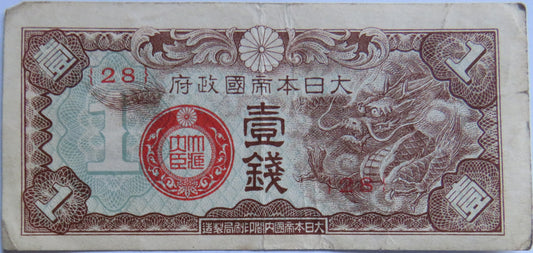
Asian banknotes cover a wide range of currencies and eras, from notes issued under British colonial administrations to independent central banks established after the Second World War.
India's rupee notes were issued by individual banks until the Paper Currency Act of 1861 gave the Government of India sole authority to issue notes. The Reserve Bank of India took over this role in 1935 and remains the country's sole issuer today. When Pakistan became independent in 1947, it continued to use Reserve Bank of India notes overprinted with 'Government of Pakistan' until the State Bank of Pakistan issued its own banknotes from October 1948.
Some of our Japanese notes date from the Second World War, when Japan issued its own currency in territories it occupied, including Malaya and parts of China. These are sometimes called Japanese invasion money. The wartime Malayan dollar notes are nicknamed banana money, after the banana tree design used on some of the notes in that series.
We also stock notes from Hong Kong, where three different banks, the Hongkong and Shanghai Banking Corporation, Standard Chartered and the Bank of China, have issued notes since the 19th century, along with notes from Ceylon (now Sri Lanka), Singapore, Indonesia, South Korea and Malaysia.