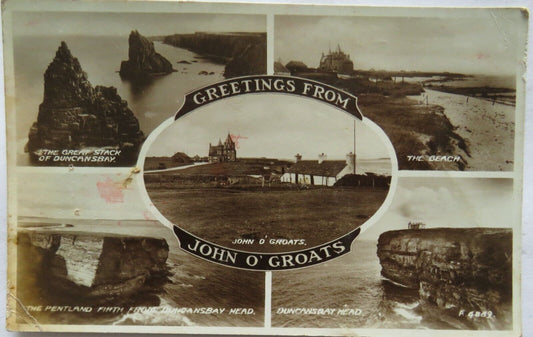
Is John o' Groats really the most northerly point of mainland Britain?
Not quite. John o' Groats is the northernmost settlement on mainland Britain and the traditional end point of the Land's End to John o' Groats journey, but the actual northernmost point of the mainland is Dunnet Head, a little further along the coast.
Why did the Queen Mother buy the Castle of Mey?
Queen Elizabeth The Queen Mother bought the Castle of Mey, then called Barrogill Castle, in 1952 while mourning the death of King George VI. She restored it and returned it to its old name, and it remained the only property she ever owned outright.
What period are these Caithness postcards from?
Most date from the early to mid-1900s, though this varies by item. Where a postcard has been posted, the postmark on the back can help pinpoint an exact date, and we note this in the listing where we know it.
Do your Caithness postcards cover towns beyond John o' Groats and Mey?
Yes, postcards from Wick, Thurso and other Caithness towns appear across the collection, and we add new stock regularly.
What condition are the postcards in?
We photograph each postcard closely so you can see its actual condition before you buy. Due to their age, some general wear is normal, such as light creasing, corner wear, or toning, and condition can vary from postcard to postcard.
How can I date an old Caithness postcard?
A postmark is the clearest clue on a posted card. Where there isn't one, we look at the printing style, the stamp box design and the publisher's mark to estimate an approximate era.
Do you combine postage if I order more than one postcard?
Yes, we combine postage across all items on our store. We post worldwide, and UK orders of £50 and over qualify for free shipping.
How are the postcards packaged when posted?
Each postcard is placed within a protective sleeve and posted in a hardback envelope, to keep it protected in transit.
Is the postcard photo the actual item I'll receive?
Yes, every photo shows the exact postcard you'll receive, not a generic or stock image.